

How to Fix Your Technique
You don't always need to 'deload to work on form,' but sometimes you do

Correcting Small vs Large Technique Errors
Small technique issues can often be corrected in the context of your normal work sets, and sometimes they are so minor that you shouldn’t think about them all. One degree of knee valgus during a heavy squat can be totally ignored in favor of putting all your mental focus on driving the bar up hard. But bigger technique issues that are fundamental to the performance of the lift can’t be fixed at heavy weights.
When using heavy weights, your focus needs to be on pushing hard enough to complete the set, and only a small amount of brainpower can be dedicated to technique. The motor pattern here has to run about 95% on autopilot, with only a tiny amount left over to focus on 1-2 small technique corrections. This is fine if your form is basically good and you’re just shoring up a small technique issue here or there. You’ll always be working to perfect something for your entire lifting career, form is never statically perfect forever. But for large fundamental issues, you need more brainpower available to focus on fixing them than the small amount available when using heavy weights.
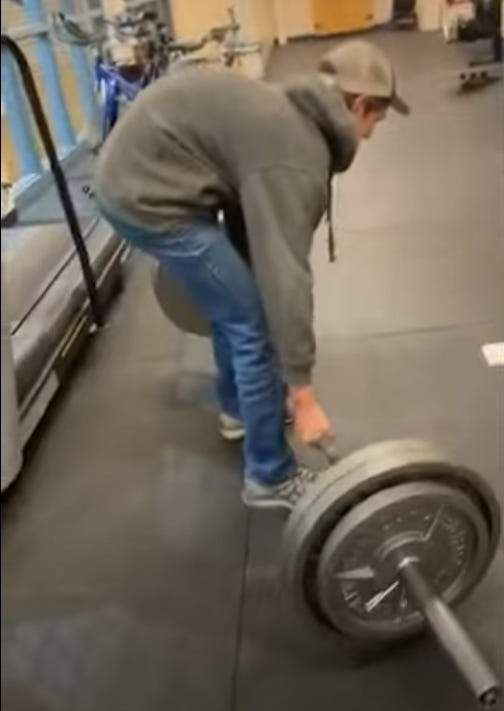
For example, if your back looks like this in the deadlift - this is not a minor form error you can fix while continuing to lift heavy and add weight to the bar. This is a complete lack of understanding of what your back needs to do in the lift, and needs to be addressed at a weight light enough to focus on it.
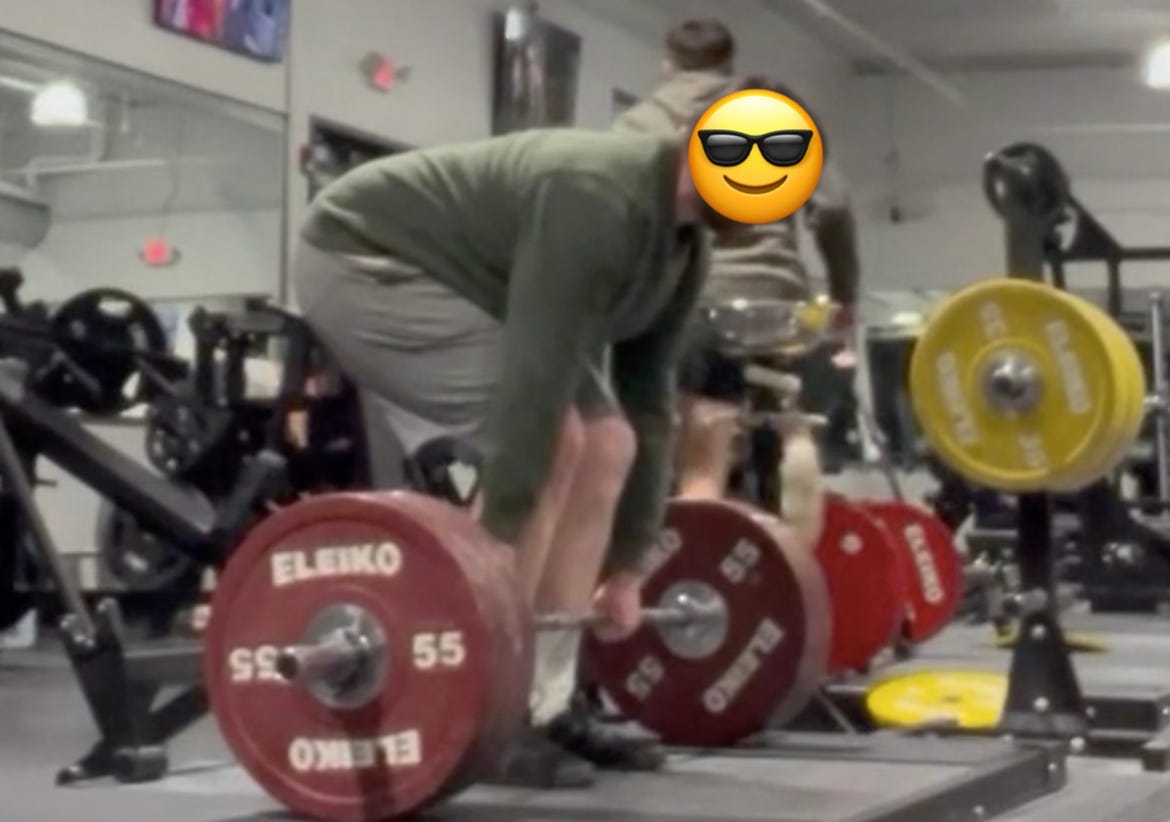
Whereas this back, though not quite as rigidly set as we’d like it to be in the lumbar region, is a minor correction that can be done in the normal context of training, without having to take any weight off the bar.
Deloading Correctly To Fix Technique
Correcting major technique issues requires re-patterning your entire movement. If the weight is heavy enough that you need ~95% of your focus to be on simply pushing hard enough to make the lift and not fail, you don’t have enough leftover brainpower to do that major re-patterning. You need to take bunch of weight off the bar to fix these kinds of fundamental technique issues, but the weight also can’t be so light that you can’t feel gravity’s pull at all. You still need to correct the issue in the context of the way the movement is normally done, against gravity. For a lifter who has already been introduced to the lifts, almost never does this involve an empty bar or a PVC pipe.
There’s no absolutely hard-and-fast rule, but working up to weights that are about 70-80% of your normal working weight (not your max) is a good starting point for this kind of fundamental technique re-patterning. It’s heavy enough to feel the weight, but still light enough to have sufficient leftover brainpower for fixing things and re-patterning.
So for a Dedicated Recreational Lifter who has recent squat maxes of 365x1 and 315x5, his regular weight for work sets across in the squat is probably around 285x5. Thus, if he has a major technique error that needs correction such that a big weight reduction is necessary, 225x5 (79% of 285) is a good estimated starting point. If you only go down to 265 or 275, it’s still so close to 285 that it’s not enough of a weight reduction to shift all that focus away from driving hard to the technique correction. If you go down to 95 or 135 or even 45 as some people think they should do, they don’t ‘feel gravity’ at all, and the combined Center-of-Mass of the lifter-barbell system is so different than 285 that it hardly even resembles the thing you will ultimately need to do. Thus, 225 is a good estimated starting point for such a case.
Working Back Up
The mistake so many people make here, is working endlessly on technique at this light weight, then at some arbitrary point weeks or months later, they jump right back up to their previous work weight and hope the technique work carries over.
No. Don’t do that, you fool.
Instead, find the correctly deloaded weight at which you can focus on fixing the issue and re-patterning your technique, then do 2-3 total sets at that weight for that workout. But don’t stay at that weight trying to “master it.” Go up a little the very next workout, even if only 5 lbs.
You have to force your body to perform the new, corrected form in the context of additional challenge. This forces all the muscles, tendons, ligaments, etc - as well as your brain that manages the motor pattern - to adapt to the new technique in all of their anatomically, biomechanically, and neuromuscularly predetermined correct proportions and amounts, with each new small weight jump.
The end result of this process is a body wholly adapted to the new technique in all aspects, by the time you get back up to your work weight. There’s no hoping or guessing if the correction at 75% will transfer back to 100%. You know it’s adapted because you forced it to adapt at each step along the way.
The amount of weight to add per workout will depend on the lift in question, as well as your strength. If you’re fixing your squat and do your routine work sets at 405x5 and you drop to 315x5 to fix it, you can make bigger jumps than someone fixing a 135x5 press that they drop to 105x5 to fix. The former might do something like 315, 325, 335, 355, 375, 390, 405 - smaller 10 lb jumps at first as they get used to the new form, then slightly bigger 20 and 15 lb jumps once they’ve gotten the basic hang of it, because it’s still submax relative to 405 that bigger jumps can be well tolerated.
The point is, despite dropping almost 100 lbs to fix the technique issue, someone squatting twice a week will usually only need a few weeks to be right back at his prior work weight but with corrected form, not endless months working with light weight, hoping at some point he can jump right back to 405 and have it be perfect.
Whereas for the 135 to 105 press, he’ll probably just use 5 lb jumps the whole way, and it would take the exact same amount of workouts (7) as the squat example above.
You have to use context and judgement here, I can’t spell out every possible example and case for you, but I have laid out the concept for you to apply under whatever your specific circumstances. Don’t let major technique errors go on, but don’t spend endless months “working on it at light weights” either, just hoping it’ll somehow be perfect at some point with heavy weight. FORCE IT TO BE, by using this process.
This is an updated version of an article that first published in March, 2024
Pretty sure that photo of the terrible, rounded-back deadlift is Sam Krapf @samkgzstrength