

Deadlifts: Still Top Tier
Deadlifts remain a key Base-Builder, despite the current Brosphere preference for RDLs

A recent reply in my twitter feed perfectly captured the current negative bro narrative about deadlifts: “They’re taxing and don’t optimally target any specific muscle. I used to do them for fun when I started lifting, but prefer RDL’s now.”
It’s a sentiment I see echoed almost daily on social media. Conventional deadlifts feel brutal, the argument goes, and Romanian deadlifts (RDLs) seem like a smarter, more targeted alternative for the hamstrings especially. On the surface, it sounds reasonable. A practical conclusion of hard-won bro wisdom developed in the trenches.
I replied:
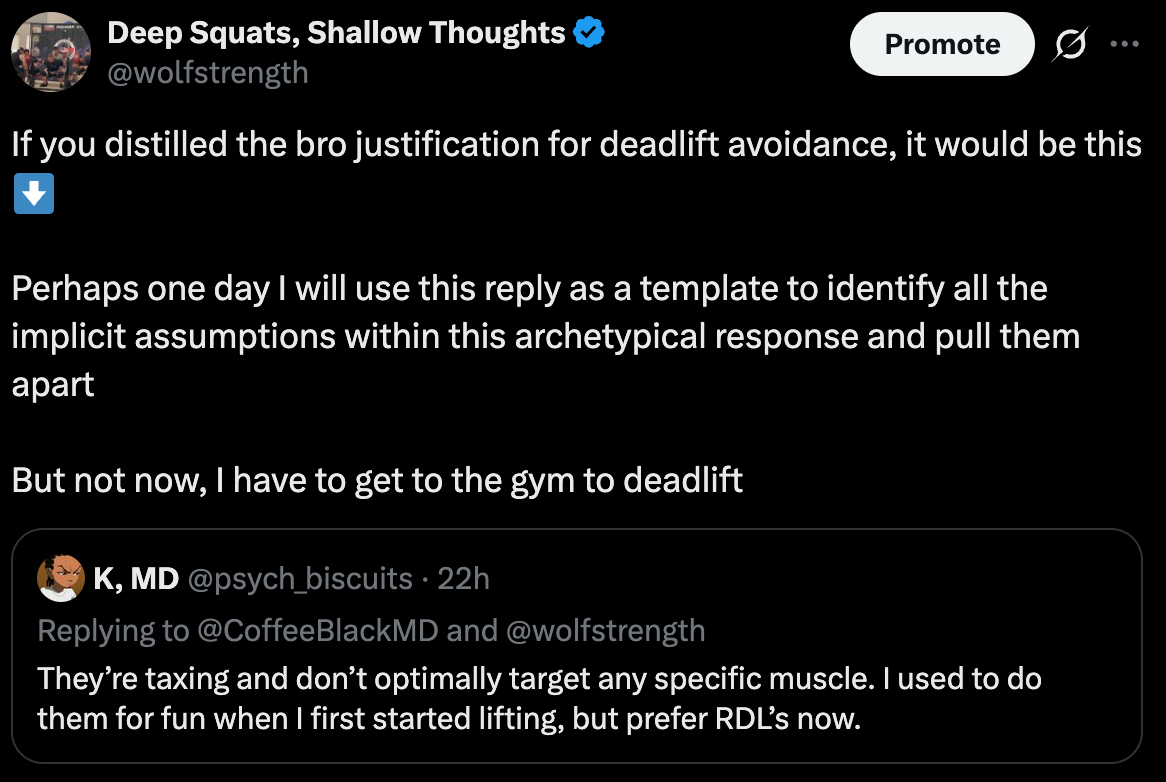
Well lucky for you, Dear Reader, today is that day.
As we dig a little deeper, I’ll show that the claim rests on three implicit assumptions that deserve scrutiny. These assumptions aren’t unique to this one tweet; they reflect a common bro style of reasoning that treats training like a menu of isolated dials to turn up or down, rather than a progressive system. The better approach starts with a clear model of how trainees actually develop: Novice → Intermediate → Advanced. From that lens, the original rationale isn’t wrong in every context, but it’s incomplete and frequently misapplied.
Deadlift vs RDL Mechanics
Before we break down the 3 implicit assumptions, a short summary of the differences between a deadlift and a Romanian deadlift (RDL).

The left photo shows the bottom of a Romanian Deadlift (RDL):
Shins stay mostly vertical
Knee angle is more open (less bend)
Hip angle is more closed (greater flexion/hinge)
Back angle is more horizontal
The right photo shows the bottom of a conventional Deadlift (DL):
Shins are more inclined/forward
Knee angle is more closed (greater bend)
Hip angle is more open (less flexion)
Back angle is slightly more vertical (but still quite horizontal)
Some of this is a bit hard to see since the photos are taken at opposite angles. This helps a bit:
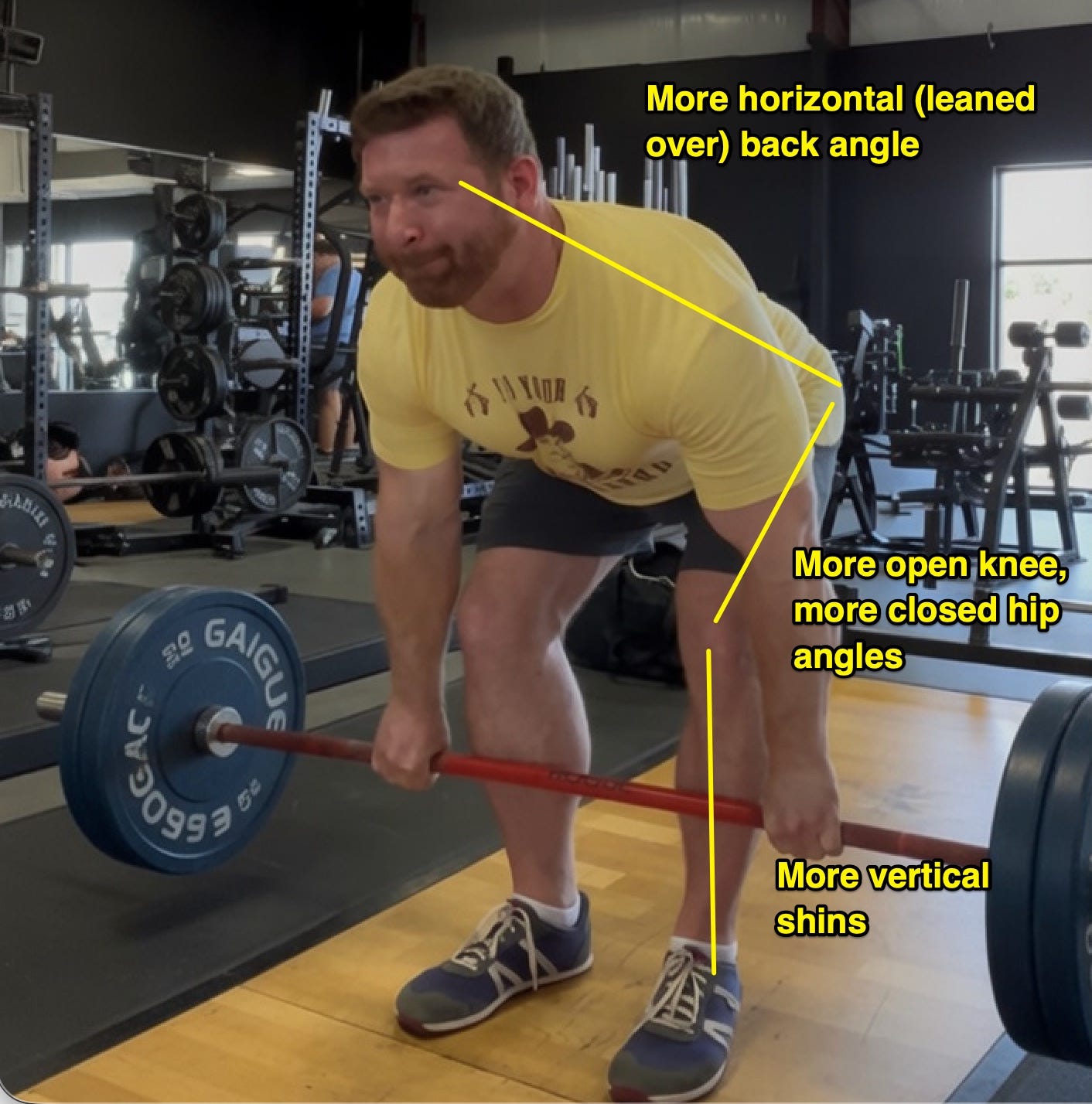
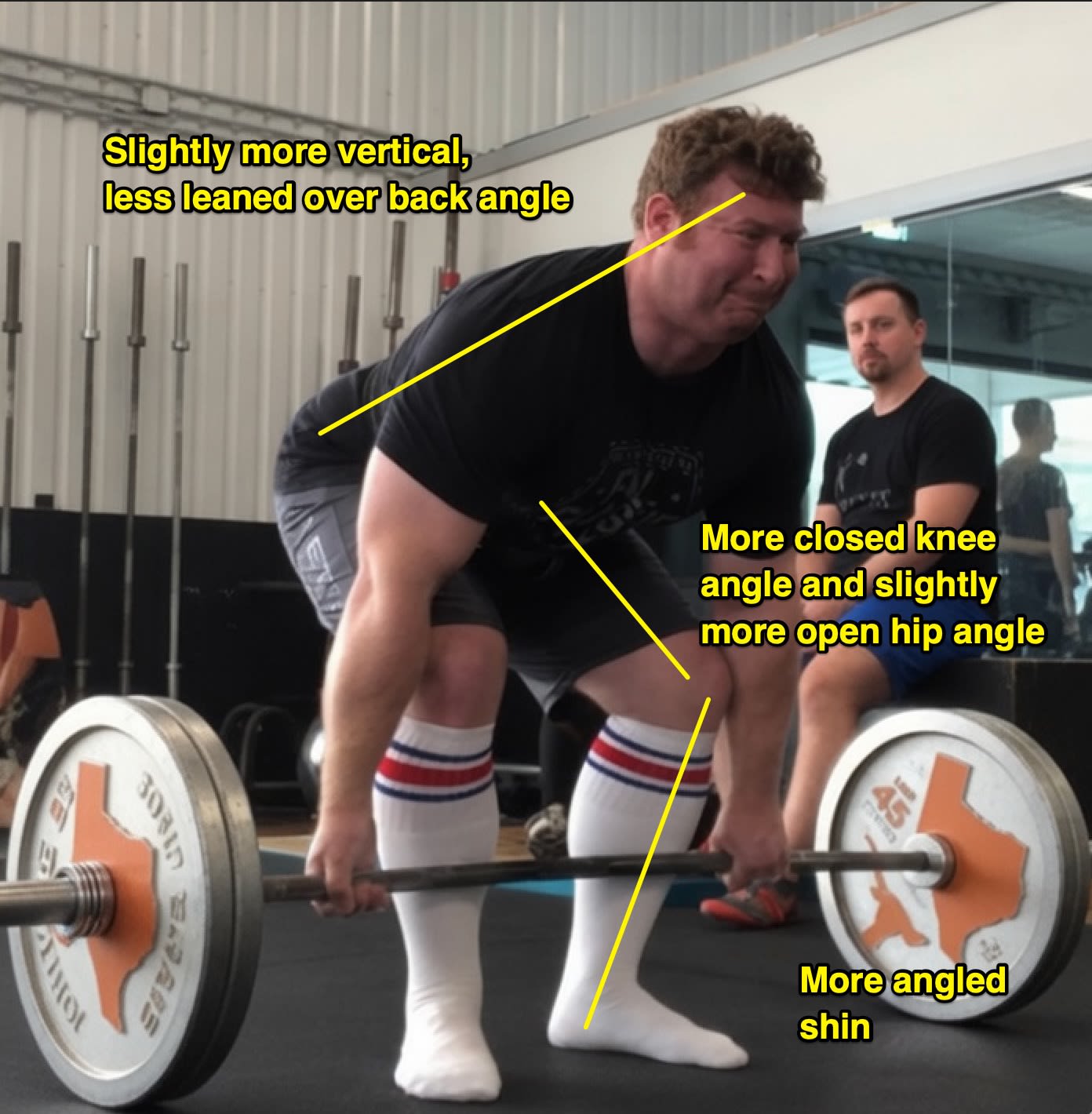
The RDL is more hip-dominant and even though I don’t love the way the term is often used, is reasonably described as a “hip hinge.” The greater hip flexion and more open knee angle place the hamstrings in a longer, more stretched position while minimizing quad involvement. This shifts primary recruitment to the posterior chain: hamstrings, glutes, and erector spinae.
The conventional deadlift is similar but involves more quad contribution via increased knee involvement. The increased knee flexion and forward shin angle create a stronger quad contribution for knee extension off the floor. The slightly more open hip and more vertical back reduce the stretch on the hamstrings compared to the RDL (though still pretty well stretched!) and allow greater overall quad + posterior chain recruitment, producing higher total force output but with a more balanced (less hamstring-specific) emphasis.
In short, the RDL maximizes hamstring length and posterior chain emphasis through a purer hip hinge, while the conventional deadlift uses more knee bend to recruit the quads and generate power from the floor. Both build the entire posterior chain, but the angle differences create distinct training stimuli.
The RDL also has a much more controlled eccentric loading component, lowering the bar under control, while the deadlift is put down more quickly.
Simplified for our purposes today, the deadlift hits the posterior chain hard with more total weight but less absolute isolation and targeting by bringing in other areas a bit more; the RDL targets and isolates the posterior chain more, especially the hamstrings, and has more of an eccentric component, but with less overall load. Usually significantly less.
The Three Implicit Assumptions
With that summary in mind, let’s unpack the 3 implicit assumptions in that post and see if they hold up to scrutiny.
First, the idea that deadlifts are uniquely and excessively taxing. Conventional pulls do seem to be more fatiguing and demand more systemic recovery than most single-joint or partial-range movements. The dead-stop nature of the lift, longer ROM, heavier absolute loads, full body involvement, grip, and trunk bracing create a bigger overall hit. Most lifters, and coaches who have logged years with hundreds or thousands of clients, will nod from personal experience that there is indeed something uniquely taxing about heavy deadlifts.
Second, the belief that it is always better to isolate and target specific muscle groups rather than apply heavier, broader, systemic stress. The tweet implies that a lift’s value is measured by how precisely it hammers one area - hamstrings in this case - rather than how much total muscle mass it trains, and adaptive stimulus it delivers, across the whole body.
Third, the conclusion that RDLs are therefore inherently superior because they are less taxing and more isolated on the target muscles. If deadlifts are too much and RDLs give you the “good” part without the downside, why keep the former in your program at all?
These three points form a tidy, self-reinforcing logic. Yet each one crumbles, or at least loses its universal force, when viewed through the lens of training progression and strength level.
Assumption 1: “Taxing” Is Not the Same as “Bad”
Yes, conventional deadlifts are systemically demanding. Anecdotal evidence from coaching thousands of lifters, and across many people reporting the same thing lines up here, regardless of what journal articles say.
But the magnitude of that extra fatigue is easily managed when volume and intensity are dosed intelligently. Don’t treat deadlifts like squats when it comes to volume - most people need less volume on deads than squats, with longer time intervals between max efforts once the early Intermediate phase is over. Don’t schedule your hardest other workouts 1-2 days after your heaviest deadlifts.
Problem solved.
Just a couple small programming adjustments mitigate this issue almost entirely.
The takeaway is simple: taxing is not an automatic reason to avoid a lift. For many lifters, that extra demand is the very feature that drives bigger long term gains. The fatigue is generated precisely because lots of stuff is working hard, it doesn’t mean nothing is being targeted enough to grow. Which brings us neatly to assumption #2.
Assumption 2: Isolation/Targeting Is a More Advanced Technique, Not a Prerequisite for Building Your Base
This is where the Novice→ Intermediate→ Advanced framework becomes decisive. For anyone who is not yet strong and lacks a solid base - roughly the first 1–2 years of serious training, depending on genetics and consistency - broad systemic lifts are superior. The goal at this stage is to train the most muscle mass over the longest effective range of motion with the heaviest loads possible. Isolation or more targeted work simply cannot deliver the same total stimulus.
A weak Novice does not generate enough absolute tension in a single muscle group to force as much meaningful adaptation through isolation alone. The deadlift’s “lack of optimal targeting” is therefore not a bug; it is a feature. It spreads a massive systemic stress across the entire posterior chain, traps, trunk, forearms, and even the pecs, lats, and triceps get some work. That broad overload produces faster strength gains, better inter-muscle coordination, and greater overall muscle growth than chasing a hamstring pump.
High responders like genetic elites or enhanced lifters can sometimes skip this foundational phase and still grow from more targeted work. They are by nature higher responders to even lower stimulus. The rest of us, however, copy their Instagram Routines at our peril. We are not outliers. We do better on growing the big compounds first.
Only once a lifter is already strong does isolation become a tool with high returns. At that point, the lifter can apply meaningful stress to specific muscle even with a narrower movement. The same RDL that once felt like a condiment, now becomes a potent accessory for addressing weaknesses or adding hypertrophy volume. Maybe for some goals, it becomes the main dish at a certain point. But not before the Novice and early Intermediate phases are exhausted, if you want to maximize your potential.
Assumption 3: Context Beats Rules
RDLs are an excellent supplemental lift. They emphasize the hamstrings and glutes, spare the lower back for some lifters by using less weight, and allow a controlled stretch under load. They deserve a place in most programs at some point. But they are not an “upgrade” over conventional deadlifts. They trade absolute load and longer range of motion for more isolation. For a Novice or early Intermediate whose deadlift is still climbing toward 405 lb, that trade-off is usually a downgrade. When your deadlift is 225, getting it strong first builds more strength and muscle than perfecting your RDL mind-muscle connection with 165
The choice is not “deadlifts or RDLs.” It is “use both, intelligently.” Doing your heaviest conventional pulls relatively infrequently (once a week for late Novices and once every 1-2 weeks for most Intermediates) along with moderating volume, mitigate the fatigue issue. For lifters who have moved beyond that phase to later Intermediate or Advanced, RDLs or other variations on some of your pulling days, rather than just doing conventional deadlifts all the time, give the best of both worlds. Personally I like to introduce the snatch grip deadlift first at this stage, but it can vary lifter to lifter based on need.
The exact ratio variations and ratios of heavy/regular DL to supplemental lifts and RDLs depends on the individual’s recovery, goals, and current strength level; not on a one-size-fits-all slogan that “RDLs hit the hamstrings harder and have a better risk to reward ratio.”
Why This Matters: Theory Over Tribal Wisdom
The real value of dissecting claims like the original tweet isn’t about Twitter Dunking or scoring points against any single post. It’s about demonstrating a more reliable way of thinking. Bro wisdom often thrives on anecdotes stripped of context: “I stopped deadlifting and my hamstrings grew more.” That may be true for an advanced lifter who already had a 405 or 500 lb pull and was chasing a specific look. It tells us almost nothing about what a 225 lb deadlifter should do next week.
A coherent theory of training development - novice, intermediate, advanced - gives us the missing context. It explains why the same movement can be indispensable for one trainee and optional or even suboptimal for another. It turns gym debates into a question of “Where is this person on the continuum?” rather than “Are you a bodybuilder or powerlifter?”
We need to cultivate this analytical habit: unpack the assumptions, test them against real-world lifting and coaching data (with people who have actually used this deeper framework, not people who only operate within the limited “target and isolate” system), then place them inside a progression model. I predict that this will beat blanket rules and a sole focus on isolate+target, every time. It keeps programming flexible, progress steady, and ego in check.
Next time you hear “deadlifts are too taxing with a bad risk to reward ratio, so I just do RDLs now,” pause and ask some follow-up questions: How strong is the lifter? How long has he been training? Is he a Novice, Intermediate, or Advanced based on stress→recovery→adaptation cycle length? What are his actual goals? The answers almost always reveal that a training progression framework is absent, and that the biggest compound lifts still have a lot to offer.
Agreed. Do both. If I can only pick one though, it’s the DL. Should have started doing them a long time ago. Also, I will typically pick a more complex movement instead of isolation because my goal is functional strength, which is what I tend to use living life.
Another factor in #2 is that even though the % of stress may be more direct doesn't mean that the overall stress is.
Say you deadlift 405 and RDL 225; both for 5's.
Let guess that your hamstrings only contribute to 50% of the lift, but 75% of an RDL.
The stress from DL's is 202.5 and the only about 170 for RDL's.
So the hamstrings are "targeted" more from DL's.
Those number are obviously not exact, but they are different enough to make the conclusion otherwise.
If anything I think DL's win by a better margin.