

Straps, Squats, and the Systems vs Reductionist Divide
Why isolationmaxxing misses part of the picture

Go into any gym and you will observe a familiar sight: An under-muscled lifter walks up to the lightly loaded lat pulldown or seated row, sits down, and immediately wraps lifting straps or versa-grips around the handles before they have even broken a sweat.
If you ask them why, they will usually say something like: “I don’t want my grip to limit how much work my lats can do. My back can handle more weight than my hands can hold.” Mechanically, for a single set, this reductionist argument makes sense. But for many novices, it can limit important neurological and structural adaptations that come from training the body as an integrated system.
By viewing the body primarily as a collection of isolated muscles rather than an interconnected system of fascia, nerves, levers, and kinetic chains, much of typical fitness advice deprives undeveloped lifters of the very qualities that would later allow reductionist methods to be more effective.
The best path is not to be a reductionist denier, but to understand and utilize both a systems and reductionist lens, each in its proper place.
This article is not meant to be a definitive academic proof. It offers a conceptual lens - the distinction between reductionist and systems thinking - that is useful and insightful to understand and reconcile many different, seemingly unrelated debates in strength training.
Before we dive into deeper into gym world, since we just celebrated the 250th Birthday of the United States, consider a similar pattern from early American history. Alexander Hamilton and Thomas Jefferson clashed on numerous specific issues: whether to charter a national bank, what kind of economy the young nation should pursue, how powerful the federal government should be, the role of tariffs, foreign alliances, and even how broadly or strictly the Constitution should be interpreted.

At first these appeared to be unrelated policy disagreements. Yet most of them stemmed from a single deeper conceptual divide. Hamilton viewed the new country as an interconnected system: a single energetic nation that required coordinated finance, manufacturing, infrastructure, and strong central institutions to flourish. Jefferson viewed it more as a collection of largely independent states and self reliant individuals, where the primary danger was excessive central power eroding local liberty and agrarian virtue.
A single fundamental lens - different ways of seeing the whole versus the parts - brought clarity to a wide range of practical arguments, some of which still echo today. A similar underlying divide runs through lifting world, as we will explore here.
1. The Fundamental Divide: Reductionism vs. Systems Thinking
Reductionist Thinking (the common bro or bodybuilding/social media approach): treats the body as a set of completely independent parts. The goal is to maximize mechanical tension and stimulus in one target muscle while removing anything that gets in the way (grip, stabilizers, fatigue, etc...).
Systems Thinking (the holistic approach): Views the body as an interconnected web. The goal is to improve movement efficiency, total structural stress and adaptation, neural drive. The nervous system organizes gross movements in the proper ratios determined by biomechanics and anatomy, not by individual muscles in isolation.
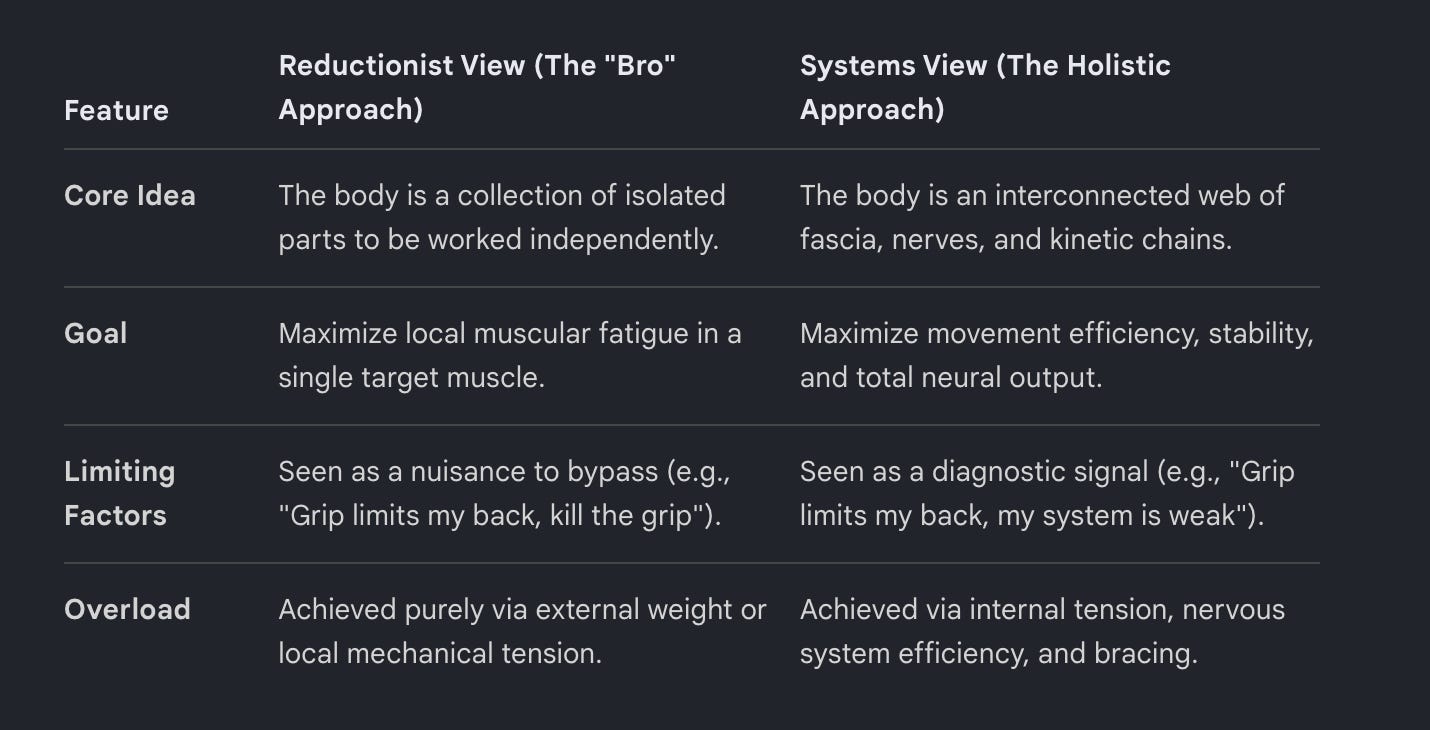
To return to our opening example, when a novice uses straps from the very beginning, he is operating almost entirely in the reductionist frame. This comes with trade offs.
2. Acute and Chronic Effects of Strap Overdependence: Reduced Neural Irradiation and Lack of Development
Think of your nervous system like a water hose. When you squeeze your glutes, or clench your fists, you turn the water tap on. The water (neural signals) starts flowing. Because the water is moving fast, it easily pours out into other pipes (neighboring muscles), engaging your entire body and creating a solid, braced structure. In lifting circles, this is called irradiation, and it has both acute and chronic effects on your lifting ability.
Acutely, you squeeze hard on a barbell or dumbbell or lat pulldown handle, and your forearm, biceps, and shoulder immediately harden. A strong contraction in the forearms and hands facilitates tension in nearby muscles through neural overflow. Your brain senses a high force demand and automatically recruits neighboring motor units to stabilize your joints and protect you from injury, while facilitating greater force production.
Because of irradiation, a powerful grip potentiates the rest of the kinetic chain.
When a novice uses straps, they bypass this active tension. The hand squeezes less hard, even if you try not to; the nervous system reduces its overall threat response (neural drive drops), and the lift becomes less of an active, braced pull. You lose the acute neurological boost.
Chronically, while you cannot “build” irradiation like you can bigger muscles, you do build the neurological skill to use it more effectively. Over months and years of practice, you develop:
Greater Neural Drive: Your brain becomes better at sending high frequency electrical signals to your muscles, allowing you to create a harder, more intense voluntary contraction.
Coordination and Timing: Advanced lifters can instantly route that “tension spillover” exactly where they need it. For example, timing a quad squeeze precisely as they drive an overhead press through the sticking point - this is part of why advanced lifters get quad cramps in the press while novices typically don’t.
Motor Unit Recruitment: Over time, your body becomes more efficient at waking up dormant muscle fibers during that sudden burst of tension.
Relying on straps entirely instead of your own grip can reduce this facilitatory effect. Even if you try to grip hard with straps, everyone who’s done both knows you can’t replicate the grip effort of knowing you’ll lose the handle if your grip fails, vs knowing you’re strapped in. This is similar to the way a power clean forces you to commit to a full explosion vs a high pull, where you are not committing to catching the bar on the shoulders no matter what.
Relying on straps too much or too early in development can slow the growth of grip strength, forearm muscles, and the ability to create full body tension. If the nervous system perceives that the wrists, forearms, and shoulders are not yet robust enough to handle heavy loads safely, it may limit force output as a protective mechanism. You cannot build the biggest possible back if the structures that support it remain underdeveloped.
The reductionist argument claims: Lats can handle 250 lbs, grip can only handle 200 lbs, therefore use straps to maximize lat growth.
While mechanically true for a single set, the systems view identifies the tradeoffs, especially for a novice:
If a novice straps up immediately, they may create a systemic bottleneck by missing out on developing high threshold motor unit recruitment and grip strength and endurance. Eventually, even with straps, their lifts may plateau sooner because the brain will artificially limit force output (via Golgi tendon organs) if it senses the hands, wrists and other local structures are too weak to support the load.
The way I see this in real life: I have no problem with a guy who can do 100lb DB rows for a set of 10 without straps, then going ahead and strapping up for 120x10 - his base is already solid. But the guy who straps in from Day 1, because online influencer guy said “don’t let your grip ruin back day,” a year later often still can’t even do 70x10 with his own grip. He has to strap in for the 70s. I have no problem with a guy strapping in for his deadlift set at 455 if he can pull 405 without straps, but the guy who starts strapping in at 135 might never get to where he can use his own grip to pull 405.
These numbers are just examples but they illustrate the concept: build a base of strength first before relying on advanced tools. The tool is not inherently bad, but is often used inappropriately.
3. Blending Reductionism with Systems Thinking
Reductionism works very well for a specific purpose: maximizing muscle hypertrophy in more advanced lifters who already have a solid base of systemic strength and coordination.
As we explored, by using straps too early you reduce the rich sensory feedback coming from the hands, one of the body’s most important sources of information for organizing that full body irradiation and global tension.
On the other hand, eventually you SHOULD use straps for your heavy sets of RDLs, not just as a last resort option but as the preferred method, so that the hamstrings actually get enough work from them.
How do we harmonize this seeming contradiction?
The Systems Level Approach
To merge both worlds, we use a systemic progression rather than an “always or never” rule:
Earn your straps: Novices should never touch straps until their grip and general strength is reasonably developed.
Double-Overhand / Hook Grip First: Build the base physical and neurological capacity.
Use straps as a tool, not a crutch: For movements like RDLs and DB rows, where you want to eliminate grip strength from limiting the target muscles, do warmup sets without straps. Only put them on for the sets of when the grip will fail while the target muscle still has gas in the tank. Exactly when this is will vary by advancement level of the lifter, as well as hand size, general strength and other factors. It’s a guideline, not a checklist rule.
For movements like the deadlift, use straps for the top set or some of the backoffs, but not both. Always do at least some of your work sets with your own grip.
This approach builds the chronic neurological benefits of irradiation first, along with the base of general strength, while still allowing for localized reductionist overload later on.
You can apply the same process and guidelines to strapping for other movements too, from lat pulldowns to rows to whatever else you may do.
4. The Practical, Milestone Approach
None of this means straps are bad. They become useful tools to deliver more stimulus to a target muscle once the foundational system is strong enough to fully benefit from them.
I am going to put the cart before the horse here, and give the practical recommendation summary before the rest of the conceptual exploration. If you mainly want tactical tips, all you have to do is read through the end of this section and you’re good.
If you’re the type who likes deeper understanding and conceptual exploration, the remainder of the article will explore how this systems vs reductionist divide also underpins several other common debates in the lifting world: Free weights vs machines, the sets per bodypart per week model, do squats train the hamstrings, and other debates and questions can all be more fully understood through this lens, as we will explore.
That said, practically speaking, here is a simple progression:
Phase 1 – Novice (Build the Foundation)
Focus primarily on linear progression in the basic barbell lifts. Rows and chin-ups or pulldowns are the only accessory lifts right now. Minimize or avoid straps on main sets. The goal is to develop grip strength, bracing capacity, and overall coordination together with overall systemic strength progress.
Phase 2 – Early Intermediate (Finish the Foundation)
Continue focusing primarily on basic barbell lifts, with PRs coming a bit less often but still fairly frequently (once every 1-2 weeks). A few more supplemental lifts may be introduced here (close grip bench, pause squat), but the program is still both very simple and very barbell-centric. Try to avoid using straps yet, which means you’ll need to learn to either hook grip or mixed grip your deadlifts.
Phase 3 - Late Intermediate (Strategic Isolation)
Once linear progress on the main lifts slows and absolute loads are significantly higher, introduce straps, machines, and other more isolated accessory work, but strategically. Use straps EITHER only on backoffs, or use them only for the top set but not warmups or backoffs - don’t use them for both. Use machines or other accessory work to add volume to specific areas without excessive systemic fatigue: RDLs, direct arm work, lateral raises, hamstring curls and leg extensions, hack and pendulum squats.
The options open up. Don’t add in everything all at once - it’s like a diner menu: many options, but you only order a few things for any given meal.
Phase 4 - Advanced (Personalized Plan)
At this stage, the lifter is specializing in what he needs to accomplish his specific and particular goals. If it’s more of a bodybuilding or aesthetics focus, he will have moved to more of the reductionist approach by now, maybe wholly. If he is a powerlifter, he will be using strategic and targeted isolation movements to ‘work on weak points’ or bring up areas that are less directly trained by the basic barbell lifts. If he is a regular guy who just wants to generally “be strong and look jacked,” he will probably be on some kind of powerbuilding program that incorporates elements of both.
There’s no one right answer for an advanced lifter - he needs a program that is individualized to the way he responds to training, and specific to his goals.
If all you wanted was the basic idea and the practical recommendations, you’re set. For those who want to understand why this progression works, and how the Systems vs Reductionist conceptual divide also explains and clarifies other common questions and debates in the lifting world, continue reading.
5. Barbells vs. Machines: Systemic Adaptation vs. Local Optimization
Once you understand this Systems vs Reductionist divide, you can also see how the same underlying conceptual divide undergirds differences of opinion on multiple seemingly unrelated lifting debates, similar to what we saw in the Jefferson vs Hamilton example.
We’ll start with the barbell (or free weights) versus machine debate. Many argue that machines (hack squats, chest presses, etc…) are superior for hypertrophy because they offer a better “stimulus to fatigue ratio.” Less systemic fatigue (axial loading, lower back stress) relative to the local muscle stimulus.
This view is understandable if fatigue is seen only as something negative to minimize. From a systems perspective, however, the systemic stress of basic barbell lifts is often exactly what drives broad adaptation in novices.
The Novice as an “Underdeveloped Organism” (Systems View)
In systems thinking, a complex system cannot be optimized by tweaking its individual parts in isolation if the whole foundational infrastructure is weak. A novice lifter is an underdeveloped organism. Their primary bottleneck isn’t a small chest or weak quads in isolation; it is a lack of total structural muscle mass, lack of systemic coordination, and an inefficient central nervous system (CNS). In some populations there may also be bone density issues.
Why Barbells are the Ultimate Systems Tool
When a novice performs a Starting Strength style squat or deadlift, the barbell acts as an unconstrained, chaotic system. The body must:
Create Internal Stability: There is no seatbelt or fixed track. The lifter must use extreme irradiation across the entire system to create a rigid torso, while producing enough force to lift the weight.
Manage Balance and Kinematics: The CNS must constantly calculate center of mass over the mid-foot, coordinating dozens of muscles simultaneously.
Trigger a Systemic Hormonal/Neural Response: Loading the spine heavily forces the entire neuroendocrine system to adapt, creating a massive, holistic Stress-Recovery-Adaptation (SRA) cycle that cascades benefits to the whole body.
The Reductionist Allure of Machines for Novices
The reductionist side of social media looks at a novice and says, “A hack squat isolates the quads better than a barbell squat without being limited by balance or lower back fatigue.”
This is classic reductionism. It treats the lower back and coordination as “bugs” to be bypassed rather than “features” that desperately need to be trained. The novice who spends their first 6 months barbell squatting, pressing, and deadlifting instead of on a hack squat and chest press machine will more fully develop the structural aspects of the entire system, as well as the capability and benefits of full body irradiation.
6. Sets Per Bodypart Per Week: Another Reductionist Measurement Problem
Once you start viewing training through the systems vs. reductionist lens, another popular framework reveals the same underlying divide: the modern habit of tracking and prescribing volume as “sets per bodypart per week.”
This approach treats hypertrophy as a math problem where each muscle group needs to hit a specific weekly set target (typically 10–20+ sets depending on the muscle and the lifter’s advancement). On the surface it sounds organized and precise. In practice, it is a deeply reductionist way of thinking about training.
The Problems Reductionism Creates
The first problem appears the moment you try to apply this model to real training: how do you count compound movements? Does a set of rows count toward your weekly bicep volume? What about chin-ups or pulldowns? Does a conventional deadlift count as a hamstring set, a low back set, both? If so, how much? Some coaches suggest counting compounds as “half sets” for the secondary muscles involved. Others use different fractions or subjective estimates. These rules are inherently arbitrary because the model demands that you break integrated movements down into isolated muscle contribution, something the body itself does not do.
The second, and arguably larger, problem is that this framework treats all sets as roughly equivalent units of work. A heavy 5 rep squat is counted the same as a leg extension taken to 2 reps in reserve. Both are simply “one set for quads.” This creates a distorted picture of training stress. The squat imposes massive demands on the entire system: bracing, spinal loading, coordination under fatigue, systemic muscular recruitment, and neural drive. Whereas the leg extension is far more localized with much lower systemic stress. When both are reduced to the same “one set for quads,” the model loses important information about what is actually being trained and recovered from.
These issues only exist because the framework begins from a reductionist premise: that the body is best optimized by independently maximizing stimulus to each muscle group. Once you accept that premise, you are forced to solve artificial measurement problems that a different way of thinking largely avoids.
The Systems View of Volume
A systems oriented approach does not start by asking “How many sets did each muscle get this week?” Instead it asks questions like:
What was the total stress placed on the organism?
Did the training improve the ability to produce force across kinetic chains?
Was the stress recoverable within the lifter’s current SRA (see below) timeline?
From this perspective, a heavy squat or deadlift is not primarily a “quad set” or a “hamstring set.” It is a high leverage systemic stressor that trains multiple qualities simultaneously. Adding extra isolation work on top of it is not automatically better just because it increases the set count for a specific muscle. The real question is whether the additional work creates productive adaptation without exceeding the system’s ability to recover.
This is why many lifters who follow strict “sets per bodypart” volume targets end up with programs full of machines, cables, and strapped movements. The model rewards maximizing local volume, which often leads people to bypass the very systemic adaptations (grip strength, bracing, irradiation, coordination under load) that would allow them to handle higher quality stress later.
When the Model Becomes Useful
None of this means tracking sets per bodypart is inherently bad. Like straps and machines, it can become a more valuable tool once a solid foundation already exists.
For a novice or early intermediate lifter, chasing specific weekly set counts for each muscle often distracts from the more important goal: getting stronger on the big barbell movements while developing the capacity to handle systemic stress. The best progress usually comes from focusing on movement patterns and progressive overload on compounds rather than trying to hit muscle group targets.
Once a lifter has built that base, typically after the early intermediate stage, the reductionist volume model can be layered on top more effectively. At that point the lifter has the systemic capacity, recovery ability, and training experience to benefit from finer adjustments in muscle group training volume without sacrificing the qualities developed earlier.
The same principle applies here as it does with straps and machines: reductionist tools work best when they are used to optimize an already developed system, not when they are used as the primary way to build that system in the first place.
7. The SRA Cycle: Macro vs. Micro
The idea of building the base before specializing ties perfectly into how the Stress-Recovery-Adaptation (SRA) cycle operates at a systems level versus a reductionist level.
The Novice LP is a Systemic Gains Train
During the Starting Strength novice phase, the SRA cycle is perfectly synced globally. Because the novice has so much untapped potential, a single workout of heavy squats, presses, and deadlifts stresses the entire organism. Within 48 to 72 hours, the entire organism adapts, allowing them to add 5 lbs to the bar next time.
If you introduce machines (accessories) here, you disrupt the system. Machines introduce localized, overlapping micro-SRA cycles that mess with the body’s total systemic recovery budget. Every time someone does this, the main linear progression on the big, basic lifts grinds to a halt far sooner.
Early Intermediate Training (PPST 3rd Edition) as Systemic Expansion
As the lifter moves into early intermediate territory (Texas Method, Heavy/Light/Medium), the SRA cycle stretches from a 48-72 hour window to a weekly or bi-weekly window. The system now requires a more complex wave of volume and intensity to disrupt homeostasis.
By staying with basic barbell lifts through this phase, the lifter pushes their systemic force production close to its reasonable short term limit. They finish the phase having learned how to grind, how to brace against immense loads, and how to recover from profound neural and muscular fatigue.
After this, specialization becomes far more successful.
Why the Base is So Useful for Successful Specialization
The irony of the social media reductionist argument is that a lifter who builds a barbell base will ultimately be a better reductionist than one who starts with straps and machines.
Once a lifter finishes an early intermediate barbell program, they possess a highly developed nervous system capable of strong voluntary contractions and immense full-body irradiation. Their grip is pretty well developed.
When that strong lifter transitions to more of a reductionist program that targets body parts and sits down at a chest press or a hack squat, their potential is vastly higher:
Higher Absolute Load: Instead of leg pressing 315 lbs for 10 reps, the systemic development and structural integrity of someone who spent his first year getting his squat up to 350 lbs, allows him to leg press 455 lbs safely, creating vastly higher mechanical tension on the quads.
Same for any other lift. There is obviously a limit to this, at some point you have to move on from only developing strength in the 1-5 rep range and move to a broader set of development goals, which is why I set the endpoint at the end of the early intermediate phase. But up to that point, even for a reductionist, the amount of load you can use for the same number of reps will be greater if you build the base with systems thinking first.
Superior Mind Muscle Connection? MMC is its own skill that takes some time to develop so this is a bit more theoretical, but someone who spends 6-18 months learning how to manipulate and maximize internal tension and irradiation across the entire body, might well learn to voluntarily contract a target muscle with greater force and efficiency after an initial learning curve.
Summary
The reductionist approach seeks to optimize the parts before the whole exists. The systems approach recognizes that there are advantages in forging the whole organism first via heavy, unconstrained barbell movements. Only after the global system is strong, stable, and highly coordinated does it make sense to partition it into isolated parts.
When novices jump straight into machine or isolation based programs that think only in terms of the reductionist approach: maximally targeting muscle groups and stimulus to fatigue ratios, they are trying to get local optimization at the expense of global development.
8. How the Stress-Recovery-Adaptation Cycle Changes With Experience
The reason the systems approach prioritizes barbells early comes down to how the body’s capacity evolves, using a framework laid out in Practical Programming for Strength Training by Mark Rippetoe and Andy Baker.
Novice Phase
Absolute loads are still relatively light compared to what the body can eventually handle. At this stage a squat or deadlift session creates a significant but quickly recoverable systemic stress: significant because it’s a high global stress event relative to what that person can do NOW, but recoverable because it’s not high in absolute terms or relative to what the trained body can eventually handle.
Most novices can add weight to the bar every workout or every other workout during this time. The entire system adapts together.
Introducing too many isolated/machine movements too early can fragment this process by creating multiple overlapping recovery demands, local and systemic. The clean, linear progress that comes from focusing on a few big barbell lifts stalls early, hijacking the lifter’s progress well before it would otherwise end.
Beyond the Early Intermediate Phase
Once someone is squatting or deadlifting significantly heavier weights, a single heavy session creates more systemic fatigue. Recovery now takes longer than 48–72 hours. Further, as a result of the asymptotic nature of things, more stress than a single workout - even a hard workout - is needed to yield further adaptation. Eventually the time between reliably made PRs in the basic barbell lifts moves beyond once a week or even once every two weeks.
At this point, strategic use of machines and isolation work becomes more useful, not to build the base, but to add targeted stress without overloading the system beyond what it can handle.
This is the key distinction: reductionist tools (machines, straps, isolation) are most valuable after a solid foundation exists.
9. The Bi-articular Muscle Example: Leg Press or Squat for Hamstrings
I found a post that is an excellent example of high-quality reductionist thinking, which we’ll use to further explore this conceptual divide:
Leg press is S tier for quads and glutes. Solid for adductors. Not a great option to train the hamstrings. Hamstrings need hinges and curls.
Why doesn’t the leg press give the hamstrings a good growth stimulus, regardless of foot placement? The hamstrings are a biarticular muscle. They cross (and act on) the hip and knee joint. During leg presses (and squats) the hips and knees are flexing and extending concurrently. This means that the relative length of the hamstrings does not change throughout the exercise, and they will not receive a meaningful growth stimulus.
The hamstrings have an isometric demand during squats and leg presses. So yes, they are certainly working / involved. But they are not going to be challenged enough to receive a meaningful growth stimulus."
This is anatomically precise, mechanically accurate for an isolated muscle group, and completely correct about how the hamstring operates during the movement.
However, from a systems-based perspective, it misses the forest for the trees. It treats the human body like a collection of separate pulleys in a physics textbook rather than a living, interconnected, biological organism.
The Biarticular Fallacy: The Body Wants Stability, Not Just Length
The post correctly notes that because the hip and knee flex simultaneously during a squat or leg press, the hamstring stays at a relatively constant length (isometric contraction).
The reductionist concludes: Therefore, the squat is an inefficient exercise because you waste energy on an isometric hamstring contraction that doesn’t yield growth.
The Systems Counter-Argument:
The hamstring’s isometric contraction during a barbell squat is not a “waste” of energy; it is a systemic stabilizing anchor.
Lombard’s Paradox: In a true closed-kinetic-chain movement (like a barbell squat), the co-contraction of the quads and hamstrings creates a perfectly balanced system that stabilizes the knee joint and pelvis.
The Irradiation Boost: When the hamstrings fire isometrically to stabilize the pelvis, they allow the glutes and spinal erectors to contract harder. This massive internal stability reduces the brain’s “threat response.” Because the nervous system feels completely safe and anchored, it allows for maximum voluntary neural drive to the quads.
The Leg Press Flaw: On a leg press, the machine provides the stability for you. Your back is supported, and the track is fixed. Because you don’t need to fight for stability, the hamstrings remain largely quiet. While this isolates the quads, it deprives the nervous system of learning how to co-contract muscles to protect joints under load.
Redefining “Fatigue”: Systemic Adaptation vs. Local Damage
The core of the “Stimulus-to-Fatigue Ratio” argument is that barbell squats cause too much “systemic fatigue” (axial loading, lower back exhaustion, CNS depletion) relative to the local quad stimulus. They prefer the leg press because it offers low systemic fatigue and high local stimulus.
This makes sense only if your definition of “fatigue” is purely negative.
Why Novices Need “Systemic Fatigue”
For a novice or early intermediate, the systemic stress of a barbell squat is a primary driver of progress.
When a novice squats 225 lbs, the “fatigue” they feel in their lower back, upper back, and nervous system is actually a potent Stress-Recovery-Adaptation (SRA) trigger. Their bones are getting denser, their tendons are thickening, and their brain is learning how to fire motor units across the entire kinetic chain simultaneously.
If that same novice avoids the barbell squat because of its high “systemic fatigue” and chooses the leg press instead, they bypass much of this stress in favor of a hyper localized one. But in doing so, they also bypass the bigger adaptation. They remain systemically less adapted, even if their quads grow.
The “S-Tier” Trap: Local Maximums vs. Global Maximums
In mathematics and systems design, optimization can happen at two levels:
Local Optimization: Making one specific part as efficient as possible (Reductionism).
Global Optimization: Making the entire system as powerful as possible (Systems Thinking).
The post claims the leg press is “S-tier” for quads. Locally, for pure muscle fiber tension in an advanced lifter, it might be.
But globally, for an developing lifter, it is a less ideal tool because it creates a fragmented organism. If you build “S-tier” quads on a machine, but your spinal erectors, trunk, and grip are “D-tier,” you cannot express that quad strength as well except on that specific machine.
And it’s not clear that trying to achieve local optimizations separately in every part while still an underdeveloped organism, yields even the same local optimizing results as globalmaxxing,
When you build a base with the barbell squat, you are optimizing globally. Your quads, glutes, hamstrings, and lower back all grow in a perfect, functional ratio dictated by your actual human anatomy, not by the angles of a steel machine.
That said, once a solid foundation is built - once the early intermediate stage has been completed - dedicated hamstrings movements like Romanian deadlifts, good mornings, and leg curls generally produce greater hamstring hypertrophy and development than squats and deadlifts alone. Leg press can become an ‘S-Tier” movement for the quads.
Final Takeaway
This approach does not reject the reductionist lens. It simply argues that it is most effective when layered on top of a strong foundation formed by the systems-oriented lens, rather than used as the foundation itself.
How much of the reductionist type lens is layered onto the systems lens will depend on what a given person enjoys doing and what their goals are. Most people will end up doing some of both. But the systems lens offers a fuller view of how to build a base from scratch in an untrained lifter.
Wow. That is a pretty deep dive, lots of good info, an interesting read.
My take - I have never used straps for my simple reason - if I can’t hold on to the thing I am trying to move, I cannot move it on my own. Cheating in my mind.
And, I’ve mentioned this before, my single priority now is functional strength. Therefore, a base of squats, DLs and presses with the barbell. Throw in a bit of lunging, RDL and DB work and I’m good.
Likely a simple approach for a simple man!
Excellent read, Michael.
I still buy the bro science of the hormonal effect of the big movements having a huge effect on growth.
But a lot of guys who get their hormones through other means say otherwise, so...............................